
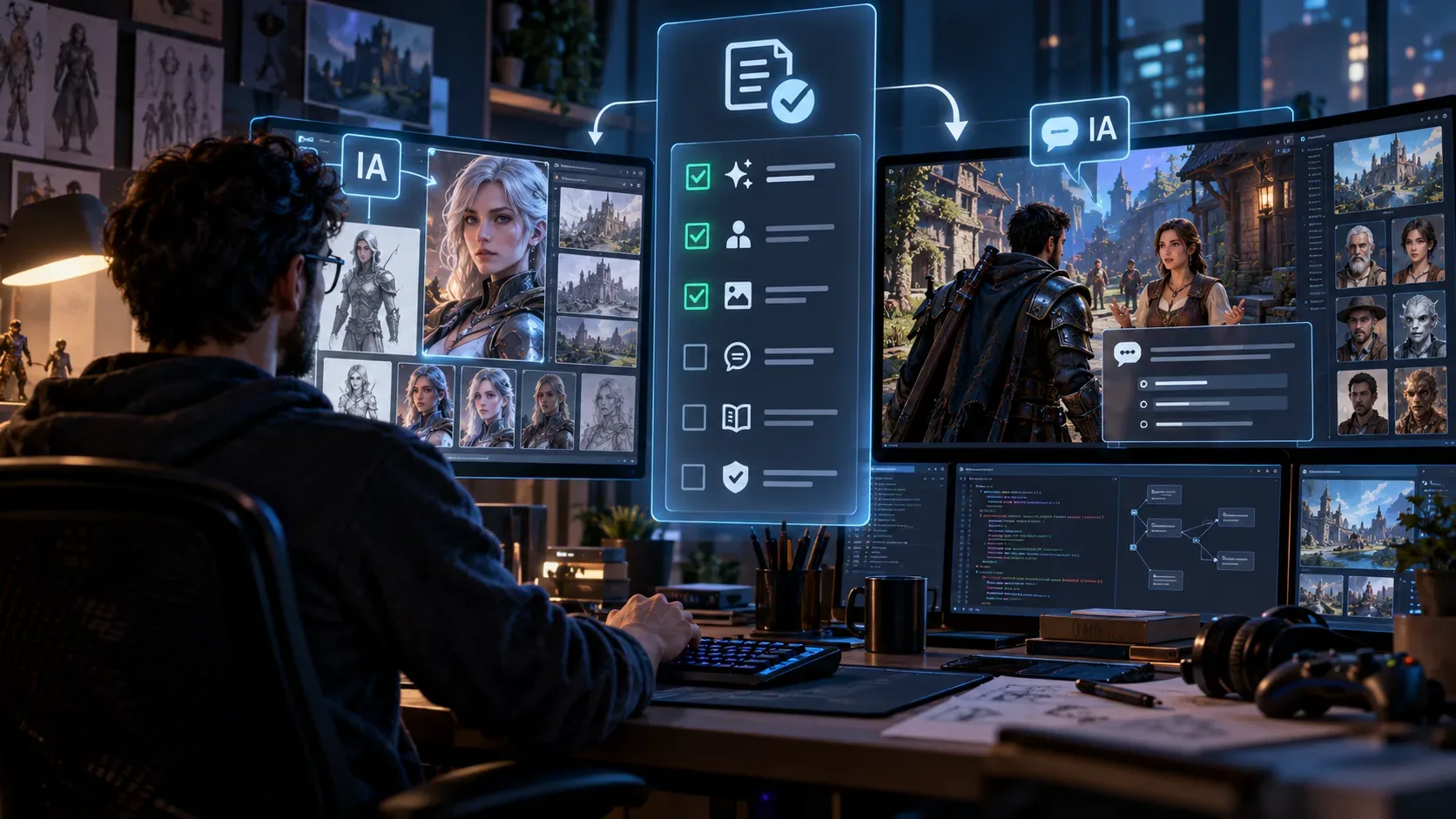
Developers planning to release a game on Steam must disclose in the Content Survey when generative artificial intelligence has been used to produce images, audio, text, or other content included in the game and consumed by players. Valve distinguishes pre-generated material, created during development, from live-generated content produced while the game is running. An NPC that creates new dialogue during play falls into the second category and also requires an explanation of safeguards against illegal content. AI tools used solely to speed up internal work, without creating content delivered to players, are not the focus of this part of the survey.
This guidance is based on the public Steamworks Content Survey documentation consulted on October 24, 2026, and coverage of the form's January 2026 revision. It is a documentation-based guide, not an account of a game submitted by DTech. The policy discussed belongs to the Steam platform; it does not establish copyright law in every jurisdiction.
What counts as pre-generated content or content generated during play?
The key question is not whether any studio tool contains AI. It is whether generative AI helped create content delivered to players, or whether the game itself uses it to produce new outputs at runtime. Valve's examples include artwork, sound, narrative, and localization, meaning text and other elements translated or adapted into different languages.
| Situation | Practical example | How to disclose it |
|---|---|---|
| Pre-generated (Pre-Generated) | Portraits, textures, voices, music, or dialogue created with AI during development and included in the distributed build. | Describe the AI-assisted content that reaches players. |
| Live-generated (Live-Generated) | An NPC creates new responses with a generative model while someone plays. | Disclose runtime generation and explain safeguards against illegal content. |
| Internal productivity assistance | An AI tool helps organize tasks or makes suggestions during development without producing player-facing content. | Efficiency gains alone are not the focus of the AI section. |
The scope also matters for store-page and promotional materials. According to Game Developer's report published on January 16, 2026, the revised survey covers AI-generated content for the game and related materials, including the store page and marketing assets. Checking only the executable files is therefore insufficient; reviewing the materials that will be shown to the public is a sensible precaution.
How to classify images and NPCs without mixing up the cases
- Art completed before release: an AI-generated illustration that was edited and included in the final build remains pre-generated content. Human edits do not, by themselves, erase the origin Valve describes as creation with AI assistance.
- An NPC with predetermined lines: if AI helped write dialogue that was then fixed in the game's files, that dialogue is pre-generated. Responding to player clicks does not turn fixed dialogue into live generation.
- An NPC that improvises: if a model creates new lines while the game runs, this is live generation, even when the developer applies filters, narrative rules, or automated review.
- A traditional NPC without generative AI: a hand-authored dialogue tree or an enemy governed by programmed rules does not become Live-Generated just because game designers call it artificial intelligence. This survey category concerns AI-assisted content generation.
These examples apply Valve's documented definitions; they are not review decisions on particular games. In mixed systems where finished artwork coexists with dialogue generated on demand, both types of use should be described according to the features actually present in the submitted build.
Documentation-based checklist before submitting the store page and build
Steamworks says developers must complete the Content Survey before submitting the store page and game build for pre-release review. The survey includes sections on general content, mature content, and generative AI content. Valve's review team compares the answers with the actual game build and store page.
- Inventory what the public will receive. Check images, sprites, textures, UI, voices, sound effects, music, narrative, translations, and store or promotional materials.
- Identify generative AI involvement. Note which content types were created with its help, what people edited, and where the output appears. Recording tools and internal steps can improve accuracy, although this is not a confirmed list of mandatory fields in the private survey.
- Separate pre-generated assets from runtime features. A recorded line differs from text produced on demand; a fixed set of portraits differs from portraits created each session.
- Describe the implementation specifically. The documentation calls for details about AI use. Avoid a generic statement that does not identify the content or explain how players encounter it.
- Document safeguards for live generation. Explain input and output restrictions, moderation, usage limits, and other measures actually implemented to reduce illegal content generation. The public documentation requires safeguards to be described but does not set out a universal list of required mechanisms in this section.
- Check rights and store-page accuracy. Valve says games must not include illegal or infringing content and must match their promotional materials. Completing the form does not replace licenses, permissions, or content review.
- Review the submitted build and record changes. After approval, some survey answers may require contacting Steam Support to change; Valve advises submitting a summary of the change and instructions for finding the affected content.
This checklist organizes public requirements editorially; it does not reproduce the authenticated Steamworks interface. Exact field names, validation messages, and behavior in an individual account have not been verified through a real submission.
What changes when an NPC uses live generative AI?
Generating content during play creates a broader control problem: developers know the system, but not every sentence or image that could appear. That is why, in addition to the obligations for pre-generated content, Valve requires developers to describe the guardrails, or safeguards, used to prevent illegal outputs. Simply saying a model offers moderation does not demonstrate that a game is protected in every situation. Disclosures should reflect measures that genuinely exist in the product.
There is also an operational issue. The official FAQ says that when a live feature relies on an external service that charges for input and output, the developer must manage access for players and use a Steam-supported payment method if passing on costs. The documentation lists including costs in the game's purchase price, microtransactions, subscriptions, or downloadable content (DLC) as possibilities; it does not mandate one business model.
One express limitation remains: in the documentation reviewed, Valve says that, at that time, it does not accept games classified as Adult Only Sexual Content that use live-generated AI for that content. This specific restriction is not a ban on all games using generative AI.
Disclosure does not mean automatic approval
Valve explicitly states that completing the survey does not waive Steam's content rules. Pre-release review examines AI-generated output under criteria also applied to non-AI content, including potentially illegal material, infringement of third-party rights, and inconsistencies between the game and its marketing.
Steam's review documentation also requires advertised features to be present in the reviewed build. For developers selling a game with generative NPCs, this makes it important to describe what already works rather than presenting a planned feature as available. Disclosure improves transparency, but does not resolve contractual, copyright, safety, or technical issues on its own.
What changed in 2026, and what are this guide's limits?
Game Developer reported on January 16, 2026, that the disclosure form had been rewritten to separate productivity tools from AI-generated content shown to the public. The public Steamworks documentation consulted on October 24, 2026, retains the Pre-Generated and Live-Generated categories and the additional requirement to explain safeguards for the latter. The revision should not be read as a general exemption for AI-generated images, audio, narrative, or dialogue reaching players.
This guide did not access a developer account, submit a build, test a generative NPC, or verify exact labels and character limits in the private interface. Before submitting, the responsible team should compare the survey shown in its own account with the public documentation and the content of the build it intends to release.