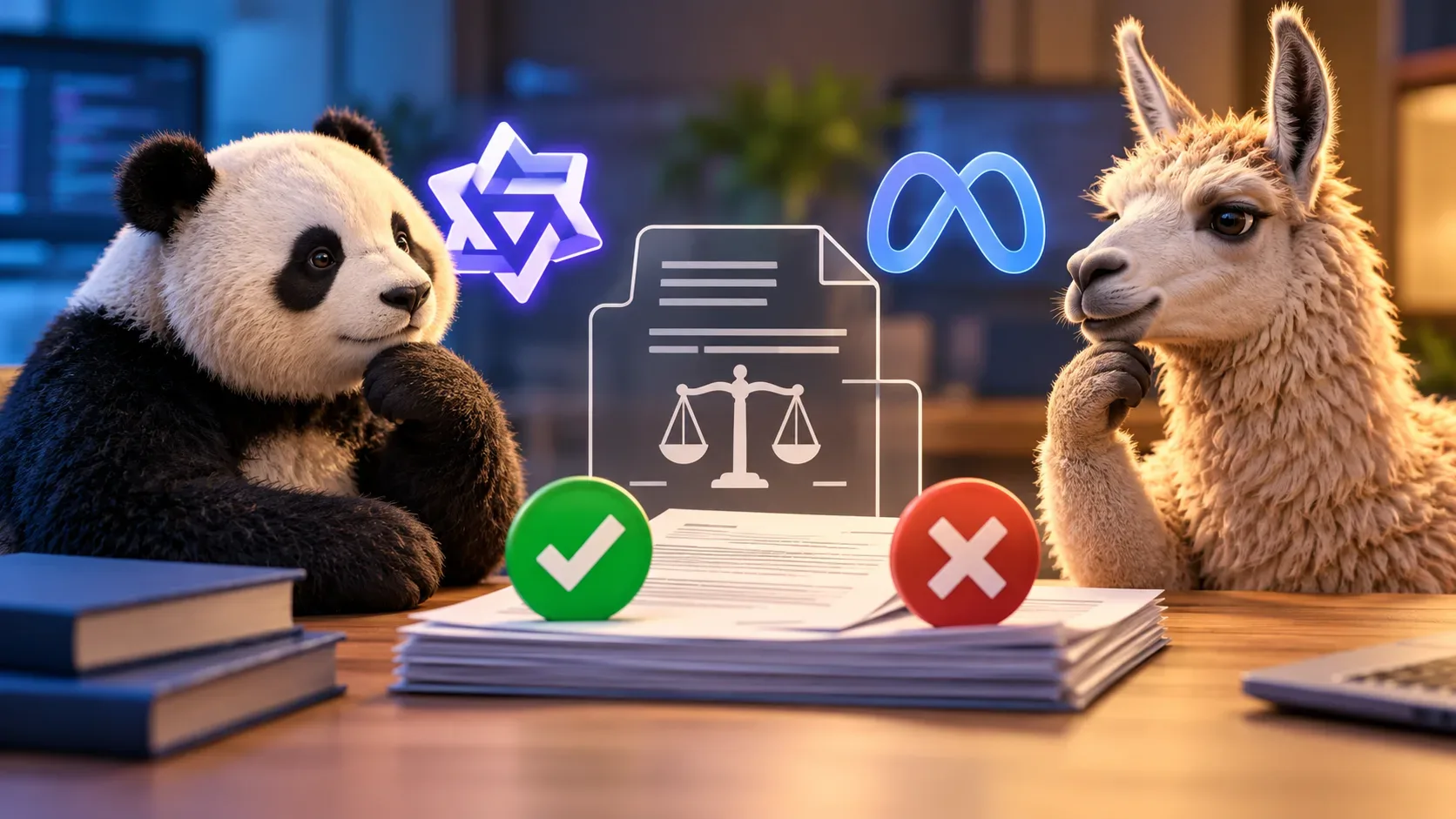
Yes. Commercial use is possible for specific Qwen and Llama models, but neither family has one universal license. In documents checked on October 24, 2026, Qwen3.8-27B is under Apache 2.0, Qwen3.8-2.4T-A95B uses the custom Qwen3.8-Max license, and Llama 4 is governed by its Community License and Acceptable Use Policy. The permissions, required notices, and business conditions depend on the exact model and how it is distributed.
For a Brazilian developer, a catalog label saying “open source” is not enough. The sensible starting point is the license in the official model-weight repository, followed by the precise variant downloaded, whether the product will be self-hosted, redistributed, or accessed through an API, and which requirements actually apply to that product.
Why Qwen3.8 does not have just one license
Qwen is a family of models from Alibaba’s Qwen team. Within Qwen3.8, the precise identifier matters: Qwen/Qwen3.8-27B and Qwen/Qwen3.8-2.4T-A95B are both maintainer-published distributions, yet their LICENSE files differ. The second repository is labeled “qwen3.8-max”, while the first contains the Apache 2.0 text.
The same caution applies to Llama. This comparison specifically covers the Llama 4 agreement, which Meta dates April 5, 2025. Its provisions should not automatically be applied to Llama 3, to other Meta models, or to third-party API services offering these models.
Open weights are trained model parameters made available for download. They can enable self-hosting when suitable software and hardware are available, but they do not mean the training data, all code, or all documentation are publicly available. They also do not waive the associated license.
License matrix: permissions, duties, and restrictions
| Model and reviewed file | Commercial use | On distribution or integration | Specific condition to check |
|---|---|---|---|
| Qwen3.8-27B | Apache 2.0 | Yes, subject to Apache 2.0 | License, applicable notices, marked changes, and NOTICE if present | No user or revenue ceiling in the LICENSE examined |
| Qwen3.8-2.4T-A95B | Qwen3.8-Max License | Yes, with additional conditions | Retain copyright and permission notice; display model name if trigger is met | Above 100M monthly users OR US$20M/month: prominent name; separate license for defined businesses above US$50M/12 months |
| Llama 4 | Community License + Acceptable Use Policy | Yes, subject to limited license and binding policy | Agreement and Built with Llama for covered distribution/integration; Notice for copies | 700M-user condition for the month before release; restriction on certain EU licensees for multimodal models |
In the matrix, “commercial use permitted” means that the reviewed model-weights license allows that activity subject to conditions. It does not mean free servers or APIs, an exemption from the law, or blanket permission for every business model. The thresholds in these agreements are denominated in monthly active users and US dollars, not estimates converted into Brazilian reais.
Qwen3.8-27B: Apache 2.0 still has requirements
The license in Qwen/Qwen3.8-27B is Apache License 2.0. It permits using, modifying, and redistributing the licensed material, including commercially. On redistribution, recipients must receive a copy of the license; modified files must carry prominent change notices; applicable attribution notices must be preserved; and notices from an original NOTICE file must be retained when such a file exists. Apache 2.0 also contains a conditional patent grant and does not provide general trademark rights.
The inspected model license sets no monthly-user or revenue cap for commercial use. That conclusion applies to this model, not every Qwen model, and does not remove the separate obligations of external software components. If the product only calls a third-party API, the service contract must be reviewed separately from the license for downloadable weights.
Qwen3.8-Max: two distinct commercial triggers
Qwen/Qwen3.8-2.4T-A95B carries the custom Qwen3.8-Max License. It permits activities including use, modification, distribution, hosting, fine-tuning, and commercial sale, subject to its conditions. Copies or substantial portions of the material must retain the copyright and permission notices.
The first trigger concerns model identification: when a commercial product or service using this model or its derivatives exceeds 100 million monthly active users OR US$20 million in monthly revenue, the applicable model name must be prominently displayed in the product interface. The agreement says “or”; both thresholds need not be met.
The second trigger calls for a separate license. If the company or an affiliate operates a Model as a Service business, providing third parties with meaningful control over model inference or fine-tuning, or an AI Work Assistant business, a standalone product mainly for AI-assisted coding or office productivity, and combined revenue across the company and its affiliates exceeds US$50 million during any consecutive 12-month period, a separate license from Qwen is needed before the covered commercial use. The clause excludes internal use where the model, outputs, and capabilities are not made available to third parties.
Those figures do not appear in the Apache 2.0 license of Qwen3.8-27B and cannot be transferred to it. Likewise, the downloadable-weight license of Qwen3.8-2.4T-A95B does not automatically replace the terms of a hosted Qwen3.8-Max offering. Products whose activities or corporate structures are close to the contractual definitions require legal review.
Llama 4: commercial permission with attribution, policy, and limits
Meta’s Llama 4 Community License grants a limited, worldwide, non-transferable, royalty-free license to use, copy, modify, and distribute covered Llama materials. When a party distributes or makes available Llama 4 materials, derivatives, or a product or service containing them, the terms call for a copy of the agreement to accompany the materials and a prominent “Built with Llama” credit on a related interface, website, or documentation. Copies of the materials must also retain the specified attribution notice in a Notice file.
There is a special rule for developing other AI models: if Llama materials or their outputs are used to create, train, fine-tune, or improve another AI model that is distributed or made available, that model’s name must start with “Llama”. This is not the same as merely producing a text response for a user, nor is it a general trademark license.
Meta’s additional commercial threshold differs from Qwen’s: if, on the Llama 4 version release date, the licensee’s or its affiliates’ products or services had more than 700 million monthly active users in the preceding calendar month, they had to request a license from Meta and could not exercise the agreement’s rights until expressly authorized. As written, this is not an automatic charge whenever that level is crossed in a later month.
The agreement incorporates the Llama 4 Acceptable Use Policy. Its prohibitions cover, among other things, unlawful activity, violations of third-party rights, fraud, and certain dangerous uses. The policy also withholds the Section 1(a) rights for multimodal Llama 4 models from individuals domiciled in or companies with their principal place of business in the European Union. It expressly excepts end users of a product or service incorporating such models. This is not a blanket ban in Brazil, but EU operations or principal establishment may need attention.
Three practical cases for developers in Brazil
- A commercial app running Qwen3.8-27B on its own server: Apache 2.0 permits commercial use and modifications, subject to license and notice requirements on redistribution. Check hosting, libraries, and data protection separately.
- A service offering Qwen3.8-2.4T-A95B to customers through an API: alongside notice and possible on-screen identification requirements, assess whether the service meets the contractual definition of Model as a Service and whether aggregate revenue triggers a separate license.
- A product incorporating Llama 4: check delivery of the agreement, Built with Llama credit, notices on distribution, acceptable-use rules, and possible naming rules for an AI model trained using Llama materials or results.
When integrating a provider-operated API, review the service terms, data-handling policy, and any output-related contract provisions as well. A weight-download license alone does not establish pricing, call limits, or ownership of everything a model generates. None of the documents reviewed guarantees that every output is free of third-party intellectual-property rights.
Checklist before launch or sale
- Record the full model identifier, publisher, downloaded version or revision, LICENSE URL, and review date.
- Define the actual activity: internal execution, integrated product, redistribution of weights, fine-tuning, customer hosting, or a third-party API.
- Check licenses and required notices in the package, website, interface, and documentation. Do not assume that a weights license covers code, data, and dependencies.
- For Qwen3.8-Max, review separately the 100-million-user or US$20-million-per-month identification trigger and the US$50-million-in-12-months trigger for businesses defined in the license.
- For Llama 4, confirm the release-date scope of the 700-million threshold, the acceptable-use policy, the EU rule, and attribution and derivative-model naming requirements.
- On switching model or variant, repeat the review. Document the contractual decision and seek legal advice where substantial redistribution, complex corporate groups, or revenue thresholds are involved.
The documentary conclusion is straightforward: “Qwen” and “Llama” are not sufficiently precise answers to a licensing question. In this review, Qwen3.8-27B and Qwen3.8-2.4T-A95B already have substantially different terms within the same generation, while Llama 4 has a separate agreement and policy. This is a guide to reading official documents, not individualized legal advice or a deployment test.