
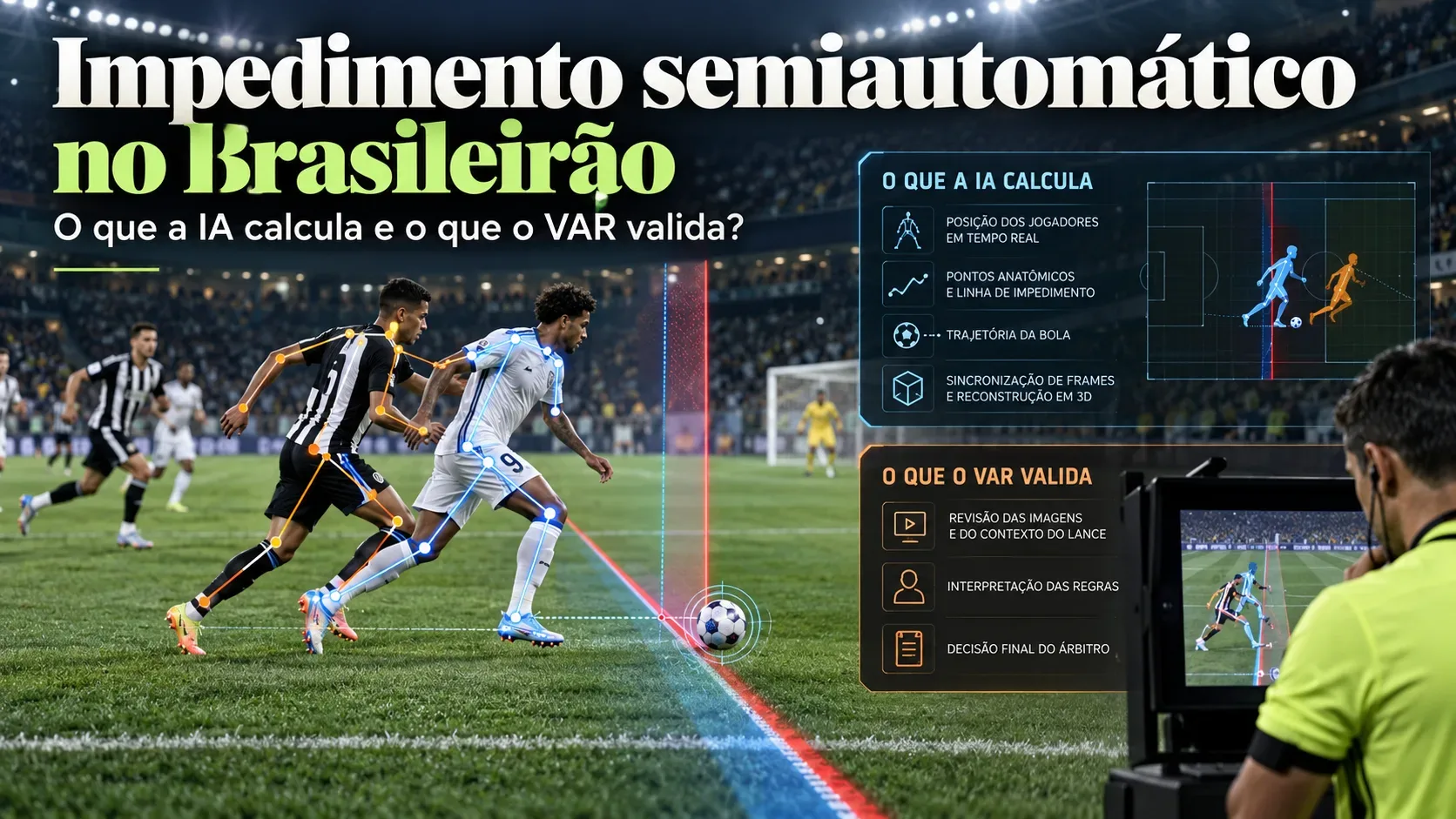
In Brazil’s 2026 top-flight football league, semi-automated offside technology uses artificial intelligence and cameras to identify the relevant moment of contact with the ball, locate players, and automatically produce offside lines and a three-dimensional reconstruction of the play. The video assistant referee (VAR) team checks the generated result, considers the context, and communicates with the on-field referee, who makes the final decision. According to the Brazilian Football Confederation (CBF), the VAR team does not recalculate positions or draw the lines manually.
The system is known as SAOT, short for semi-automated offside technology. It officially debuted in Brazil’s Série A on July 25, 2026, during matchweek 20. The crucial distinction is that being in an offside position is not itself an offence: a player’s involvement in the play must still be judged under the Laws of the Game.
What the AI calculates in the Brazilian system
On July 21, the CBF announced the use of Genius Sports’ GeniusIQ technology. According to the confederation’s July 27 report, each stadium has 28 to 32 dedicated cameras recording in 4K at 100 frames per second, as well as five local servers. The images are transmitted to the central VAR facility in Rio de Janeiro, which has ten integrated control rooms.
The system identifies the relevant attacking and defending players, tracks points on their bodies, selects the moment of contact with the ball, compares player positions and creates a three-dimensional (3D) visualization. This is automated geometric analysis, not an independent ruling on every aspect of the offside law. Recording at 100 frames per second means an interval of roughly 0.01 seconds between captured frames; that alone does not guarantee a maximum timing error of 0.01 seconds or centimetre-level accuracy.
What the VAR checks and what the referee still decides
In its July 27 clarification, the CBF said video officials review and confirm the automatically generated material. They do not move virtual players, recalculate distances or redraw lines to choose a different result. In rare cases, such as overlapping players, partial visual obstruction or uncertainty about contact timing, officials may move one frame forward or backward to verify the temporal reference. The CBF says this was not required in any of the five opening-weekend checks.
Law 11 of the International Football Association Board (IFAB) distinguishes an offside position from an offside offence. An offence requires active involvement, such as touching the ball, interfering with an opponent or gaining an advantage in circumstances specified by the law. Hands and arms are excluded when assessing position. The VAR protocol separates factual checks of player position from judgments about interference: the former can usually be resolved through VAR communication, while the latter may require the referee to review the footage on the pitchside monitor. The on-field referee retains final authority.
All five checks from the opening weekend
On July 25 and 26, the system was used five times across four matches. The official report identifies the incidents and the durations measured from the initial award of the goal:
| Match | Check outcome | Reported duration |
|---|---|---|
| Santos vs Chapecoense | Chapecoense goal by Marcinho confirmed | 48 seconds |
| Flamengo vs São Paulo | São Paulo goal confirmed | 33 seconds |
| Flamengo vs São Paulo | Flamengo goal disallowed | 64 seconds |
| Bahia vs Corinthians | Bahia goal disallowed | 32 seconds |
| Remo vs Vitória | Remo’s second goal confirmed | 62 seconds |
The CBF reported an average of 47 seconds. There is an arithmetic caveat: the five published integer durations add up to 239 seconds, yielding a simple mean of 47.8 seconds, not exactly 47. The statement does not explain the discrepancy. These figures cover only those five checks; they are not a season-wide average, an isolated AI processing time or a controlled comparison with the previous VAR workflow.
Can identifying the moment of the pass still be disputed?
Yes. During the debut, Brazilian outlet ge reported complaints that the public-facing animation highlighted the 3D offside line without displaying the instant of the pass in the same graphic. Unlike the sensor-equipped ball configuration used in some FIFA competitions, the system described for Brazil detects contact through camera images. The CBF replied that identifying the point of contact, known as the kick point, is automatic and that video officials validate the output.
A wording distinction also deserves attention. The CBF statement refers to the player’s “last contact” with the ball, while the current wording of IFAB Law 11 generally specifies the first point of contact of the play or touch, with an exception when the goalkeeper throws the ball. The consulted documents do not explain how that difference in wording is handled operationally in individual incidents. On its own, it is not evidence that any opening-weekend decision was wrong.
The 3D animation visualizes a validated analysis; it is neither independent footage nor a public record of every internal step. The documents reviewed support an explanation of the announced workflow and the five reported checks, but they do not constitute an independent technical audit of SAOT accuracy or a hands-on test by DTech.