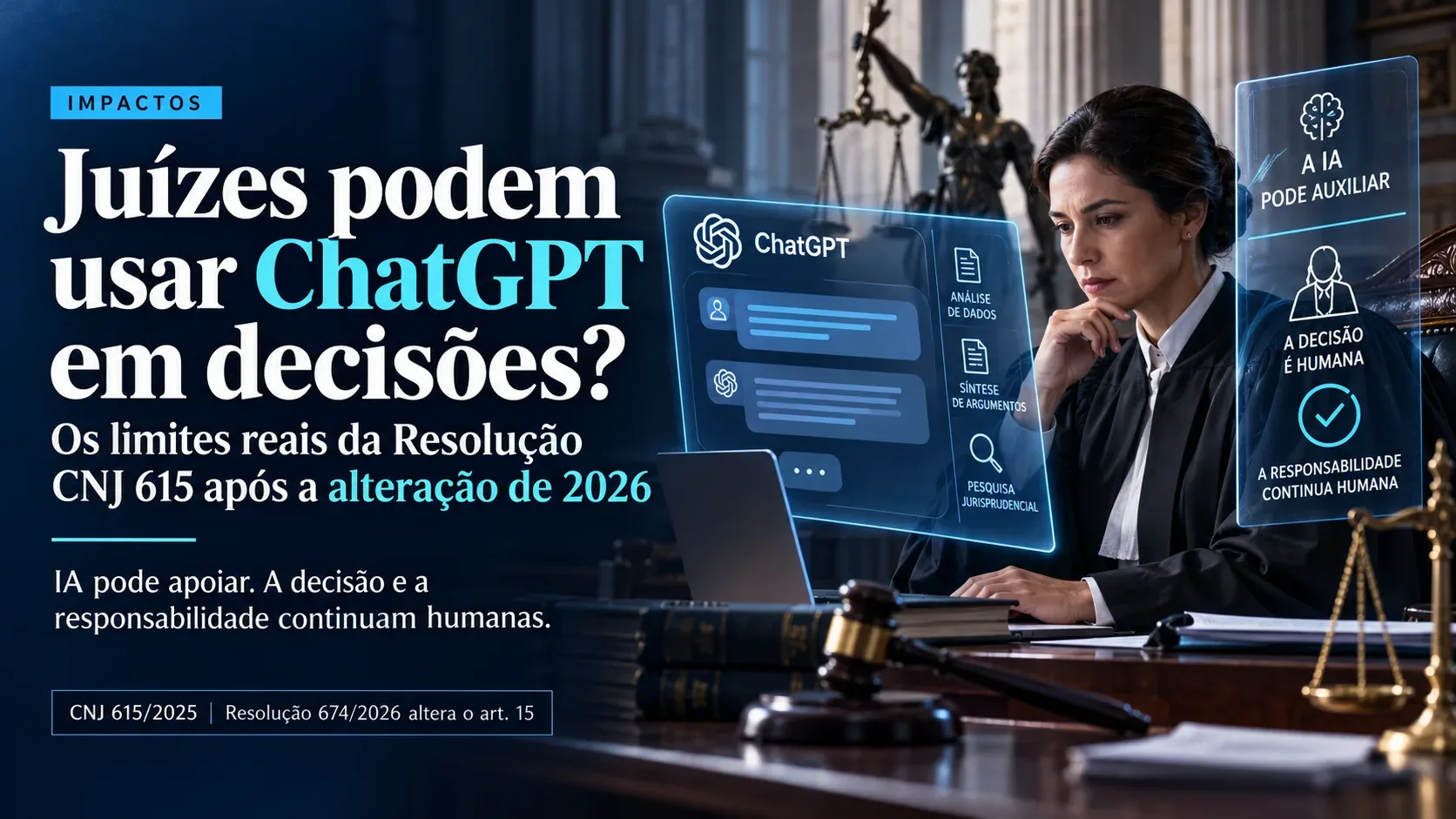
Yes, Brazilian judges may use generative artificial intelligence systems such as ChatGPT to support tasks and draft text, but they may not hand judicial decisions over to a machine. Resolution 615/2025 of Brazil's National Council of Justice (CNJ) allows such assistance subject to security, training, review and human accountability requirements. Resolution 674/2026 neither repealed that permission nor authorized previously prohibited uses: it changed the membership rules for the governance committee under Article 15.
What Resolution 615 actually allows
Article 19 covers language models and other generative AI tools available online. A language model is a system that produces text from instructions, although a fluent answer does not establish that its references to laws, precedents or facts are correct. Judges and court staff may use these tools for management and decision support, provided they comply with CNJ security standards and the resolution's other requirements.
Access enabled, provided and monitored by the court is the preferred route under Article 19(1). This should not be read as the CNJ's approval of every version of ChatGPT by name, or as an exemption from local security policies.
Can a judge use a personal ChatGPT subscription?
Article 19(2) provides for a limited possibility: where the court does not offer a corporate AI solution specifically trained and customized for judicial use, a judge, staff member or other court worker may directly subscribe to or register for a commercial tool in a private capacity. The conditions in Article 19(3) still apply. Having a personal or paid account is not sufficient on its own.
- Training: users must receive training in good practices, limitations, risks and responsible use under the program required by the resolution.
- Meaningful review: AI remains an auxiliary tool. The judge must direct, interpret, verify and review its output and retains full responsibility for the decision and the information it contains.
- Contractual and data safeguards: providers must meet data protection and intellectual property requirements. Information supplied by judicial users and data inferred from it may not be used for training, improvement or other unauthorized purposes.
- Reporting to the court: for commercial subscriptions covered by Article 19(2), the judge, or the manager responsible for a team using the tool, must report its use to the relevant court as prescribed by its regulations, under Article 19(7).
Therefore, the legal possibility of an individual subscription does not establish that any particular ChatGPT plan satisfies the technical or contractual requirements. That must be checked for the actual service and against the court's rules.
Drafting a document is not the same as letting AI decide a case
The annex to Resolution 615 treats supporting drafts of judicial documents as low risk under specified conditions, when a judge gives instructions, supervises the process and produces the final version. It also covers tasks such as summarizing documents and identifying relevant precedents in defined, supervised circumstances. Low risk does not mean unrestricted use: protected information, the particular purpose and applicable controls still matter.
The same annex classifies systems that reach conclusive judgments about applying laws or precedents to particular facts as high risk, including assessments of the nature or amount of damages. Article 19(3)(V) bars private or external AI tools from the high-risk or excessive-risk uses defined in the resolution. The distinction is between assistance in preparing material and delegating the decisive legal assessment of a case.
Article 10 also prohibits, among other uses, systems that do not allow human review, evaluate personal characteristics to predict crimes in judicial reasoning, or rank people to assess the plausibility of legal claims and witness accounts. A cursory sign-off at the end does not turn an automated decision into effective human review.
What about confidential case documents and personal data?
Article 19(3)(IV) prohibits private or external AI tools from processing confidential documents or information protected by court secrecy, subject to exceptions stated in the rule: anonymization at the source or technical and procedural measures that effectively protect the data and the people concerned. Simply removing a name from a document does not prove anonymization because other details may still identify an individual.
Article 30 adds limits on sharing information held by courts through websites, apps or application programming interfaces (APIs) when those services reuse the material to populate repositories or train and readjust models, subject to the resolution's specified exceptions and safeguards. It would therefore be unsafe to assume that a private account complies merely because an interface offers a privacy setting.
Must a judge disclose AI use in the written judgment?
Public disclosure in the judgment and internal traceability are different obligations. Under Article 19(6), when generative AI assists in drafting a judicial act, mentioning that assistance in the decision itself is optional for the judge. Automatic recording in the court's internal system, however, is required for statistics, monitoring and possible audits.
Article 33 requires clear information to external users about AI used in the services they receive and emphasizes that its advice is not binding. Article 33(3) also makes disclosure in the text of decisions optional, subject to the applicable requirements. There is no blanket obligation to add “written with AI” to every judgment, but the discretion over public wording does not remove institutional transparency, control and human oversight duties.
What did Resolution 674 change in March 2026?
Resolution 615 is dated March 11, 2025, was published on March 14, 2025, and took effect after 120 days, on July 14, 2025. Resolution 674 was issued on March 25, 2026, and published on March 26, 2026, when it entered into force.
The 2026 amendment addressed Article 15(1) and its item I, concerning the membership of the National Committee on Artificial Intelligence in the Judiciary. It provides for three CNJ councilors, all full members, rather than the two in the original text. They must include at least one member of the standing committee on technology and innovation and the CNJ councilor responsible for personal data processing. It did not amend Article 19, which governs judges' and court staff's use of generative AI tools.
Under Article 16, the committee has powers to assess commercial AI tools and the risks of using them. That authority does not amount to a blanket CNJ endorsement of ChatGPT, another brand or every possible use.
How these distinctions apply to a particular task
- Drafting a passage from information that may lawfully be used: this may form part of a support workflow if the judge instructs the tool, checks facts and precedents, revises the text and follows applicable controls.
- Uploading documents under court secrecy to an external chatbot: the general rule prohibits this, subject to expressly provided legal and technical exceptions whose effectiveness must be demonstrated.
- Asking the system to decide the merits or sentence on its own: this does not satisfy the human decision-making requirement and may involve high-risk uses barred to external systems.
- Using AI output in a judgment without checking it: this conflicts with the duty to direct, verify and review; a convincing answer does not replace judicial reasoning.
This is a document-based reading of the rules applying to Brazil's judiciary, checked on October 24, 2026. It is not based on filing a case, auditing a court or testing ChatGPT or its subscription plans. Whether a specific tool complies also depends on its actual data handling terms, any CNJ restrictions and the relevant institutional safeguards.