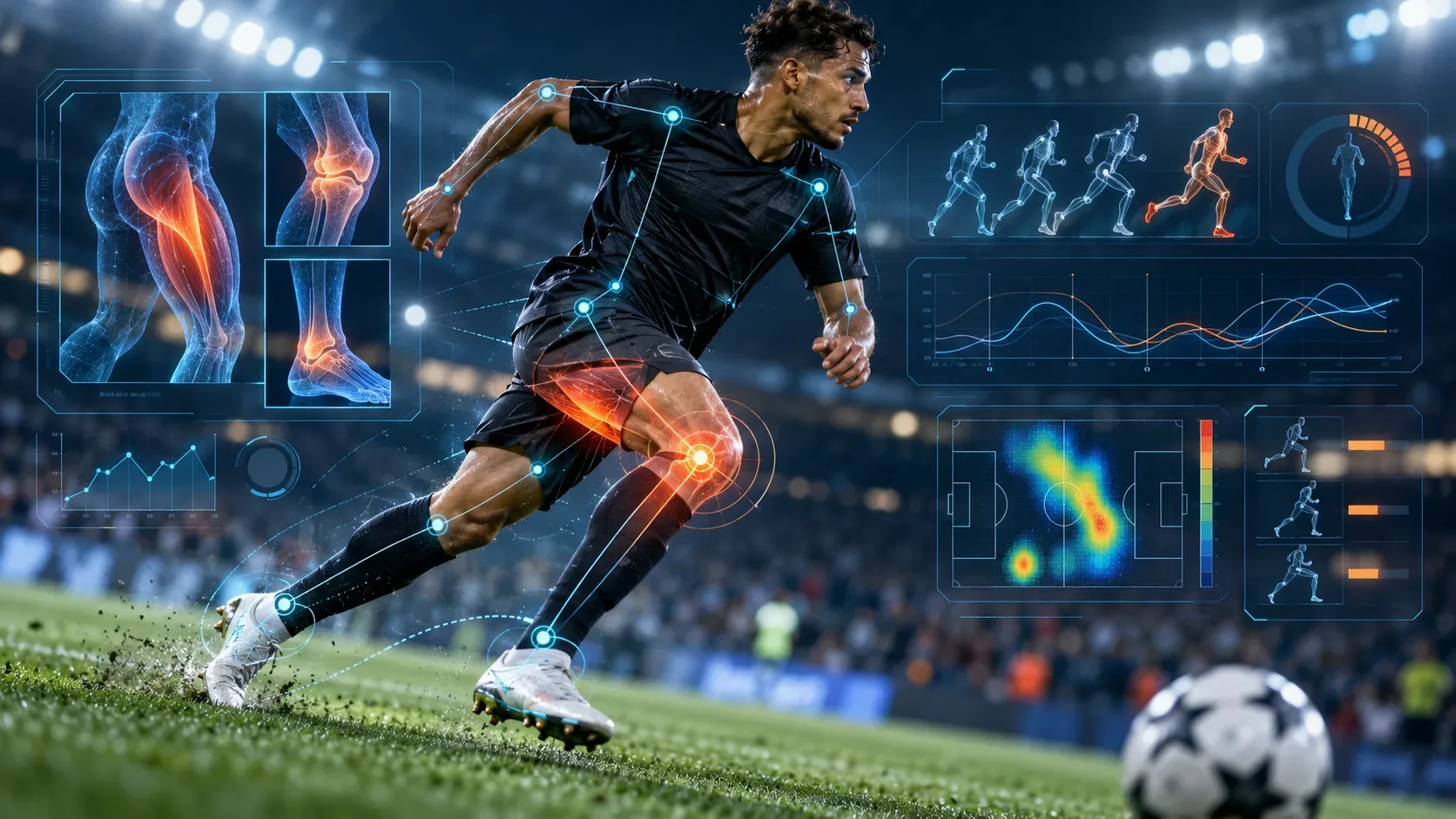
Artificial intelligence can estimate the risk of certain football injuries from training data, injury history and physical characteristics. That does not yet mean it can reliably tell which player will get hurt or demonstrate that an algorithmic warning prevents injuries. A review published on July 20, 2026, found promising results across 22 studies, but 17 were rated at high risk of bias and testing in independent populations was rare.
That distinction matters to clubs, players and medical teams. Finding patterns in past data is one task; supporting real decisions about training loads, selection or clinical care is another. The available reviews support research and potential risk-assessment assistance, not proven automated prevention.
What the AI predicts and the data it uses
In these studies, artificial intelligence usually means machine learning, in which software identifies statistical relationships in earlier examples. Models may combine distance covered, high-speed running, acceleration and GPS-derived training load with injury history, strength, mobility, age and some physiological or psychological indicators. No single factor makes an injury inevitable.
The output may be a risk category or a calculated probability for a particular period. This period, known as the prediction horizon, differs between studies: a session, several days, weeks or an entire season. The definition of injury also changes, from a muscle complaint to an injury causing time loss or one involving contact. Two performance percentages cannot therefore be compared directly when they measure different outcomes over different periods.
Researchers observed more favorable signals for soft-tissue and noncontact injuries than for injuries involving collisions, but cautioned that definitions were inconsistent. A forceful challenge by another player, for example, cannot be anticipated in the same way as a workload pattern.
What the football-specific review found
Mehdi Aslani and colleagues assessed 22 studies of machine-learning models for injury risk in football players. Their search covered research published through October 2025, and the review appeared in the Journal of International Medical Research on July 20, 2026. Reported accuracy ranged approximately from 55% to 96%, but those figures came from different datasets, definitions, methods and prediction horizons. The authors did not calculate a pooled effectiveness estimate because the studies were too heterogeneous.
Using PROBAST, a tool for assessing risk of bias in prediction-model studies, the reviewers rated 17 of the 22 studies, about 77%, as high risk; four were unclear and only one was low risk. Weaknesses included small samples, few injury events, inadequate handling of missing data, incomplete reporting and possible overfitting to the dataset under study. These categories reflect confidence in study methods, not the injury risk of an individual player.
The review itself states that models may have exploratory value for risk stratification, but the findings do not support routine deployment as autonomous injury-prevention systems. It also found no algorithm that consistently outperformed all others.
What reviews across other sports add
A systematic review and meta-analysis published by Sijie Lou and colleagues on June 24, 2026, pooled 10 models from 10 independent studies across different sports. Pooled sensitivity was 0.79, with a 95% confidence interval of 0.66 to 0.87; pooled specificity was 0.71, with an interval of 0.61 to 0.80. Sensitivity is the proportion of injury cases correctly flagged; specificity is the proportion of noninjury cases correctly ruled out. These are pooled estimates for the selected studies, not guaranteed rates for a football squad.
One limitation is decisive: none of the 10 studies in that analysis performed external validation. The authors also identified sample-size problems, methodological differences and frequent reliance on data from a single club or league. In that review’s bias assessment, seven studies were classed as low risk and three as unclear. This grading is not directly interchangeable with the football review: the selected studies and assessment procedures differ, and a low bias rating does not establish performance in a new setting.
A further review by Chu-Hsuan Lee and colleagues, published on June 11, 2026, summarized 18 studies across various sports. According to the accessible scientific abstract, only one study, or 5.6%, was rated at low overall risk of bias. It also identified limited external validation and an overrepresentation of male participants. The full article was access-restricted during this review, so these statements are attributed only to its published abstract. The study counts from the three reviews must not be added together because their searches and inclusion criteria may overlap.
Why 95% accuracy can be misleading
Consider a hypothetical example of 100 observation periods, five ending in an injury and 95 without one. A system that always predicts “no injury” would be correct 95 times out of 100, giving it 95% accuracy. Yet it would miss all five injuries. This is an illustration, not a measured result in football players, of class imbalance: injury events are much less common than noninjury observations.
That is why sensitivity, specificity and the precision of alerts, meaning how many alerts correspond to actual injuries, also matter. The area under the receiver operating characteristic curve, commonly called AUC, indicates how well a model distinguishes cases with and without events across decision thresholds. It does not show whether the individual risk probabilities are correct. The match between predicted risk and the observed event frequency is called calibration.
False negatives may miss athletes who go on to be injured; false positives may cause unnecessary restrictions on training or participation. Usefulness depends on the real frequency of injuries, their type, the prediction period and the action a team would take after an alert. Without that context, a high percentage alone has little clinical decision-making value.
External validation is the test still missing
Internal validation partitions the available data for model development and testing, sometimes using cross-validation. It helps detect errors, but cannot by itself establish whether a method works at another club, league, age group, sex or season. External validation uses genuinely independent data, keeping the model fixed and checking whether its performance and calibration persist. The football review found that this step was rare, while the multi-sport meta-analysis found none among its 10 studies.
Data leakage is another concern. If nearby records from the same player or season are randomly split between development and testing, an algorithm may recognize characteristics it has already seen and appear more accurate than it would with an unfamiliar group. Time-based evaluation and separation by player or team, as appropriate to the question, provide stricter tests. A small study with many readings from the same athlete is not automatically equivalent to one with many independent athletes.
Responsible assessment should report who was studied, how many actual injuries occurred, which information was available before each event, how missing values were handled, how the model compares with simpler methods and how it performs in independent samples. Representativeness matters, especially because broader reviews found male-dominated cohorts.
Predicting risk is not evidence that prevention works
Even a well-validated prediction model would need to be evaluated as an intervention. To demonstrate prevention, researchers would have to study what happens when teams actually act on alerts, with appropriate comparison groups, transparent protocols and outcomes such as new injuries relative to training or match exposure. A higher AUC or accuracy score does not, by itself, demonstrate fewer injuries.
Any practical decision also depends on clinical examination, symptoms, history, sporting context and qualified professional judgment. Players’ health and performance data require careful controls over access, purpose and privacy. A risk score is not a diagnosis and should not, on its own, determine withdrawal from or return to play. These are safeguards for use, not claims that the reviews validated an AI-based clinical protocol.
The answer is therefore useful but limited: AI can already identify patterns associated with football injuries and contribute to injury-risk research. What still needs strong evidence is whether those patterns carry over to different squads and whether acting on them improves real outcomes. Until then, expert assessment should take precedence over automatic recommendations.