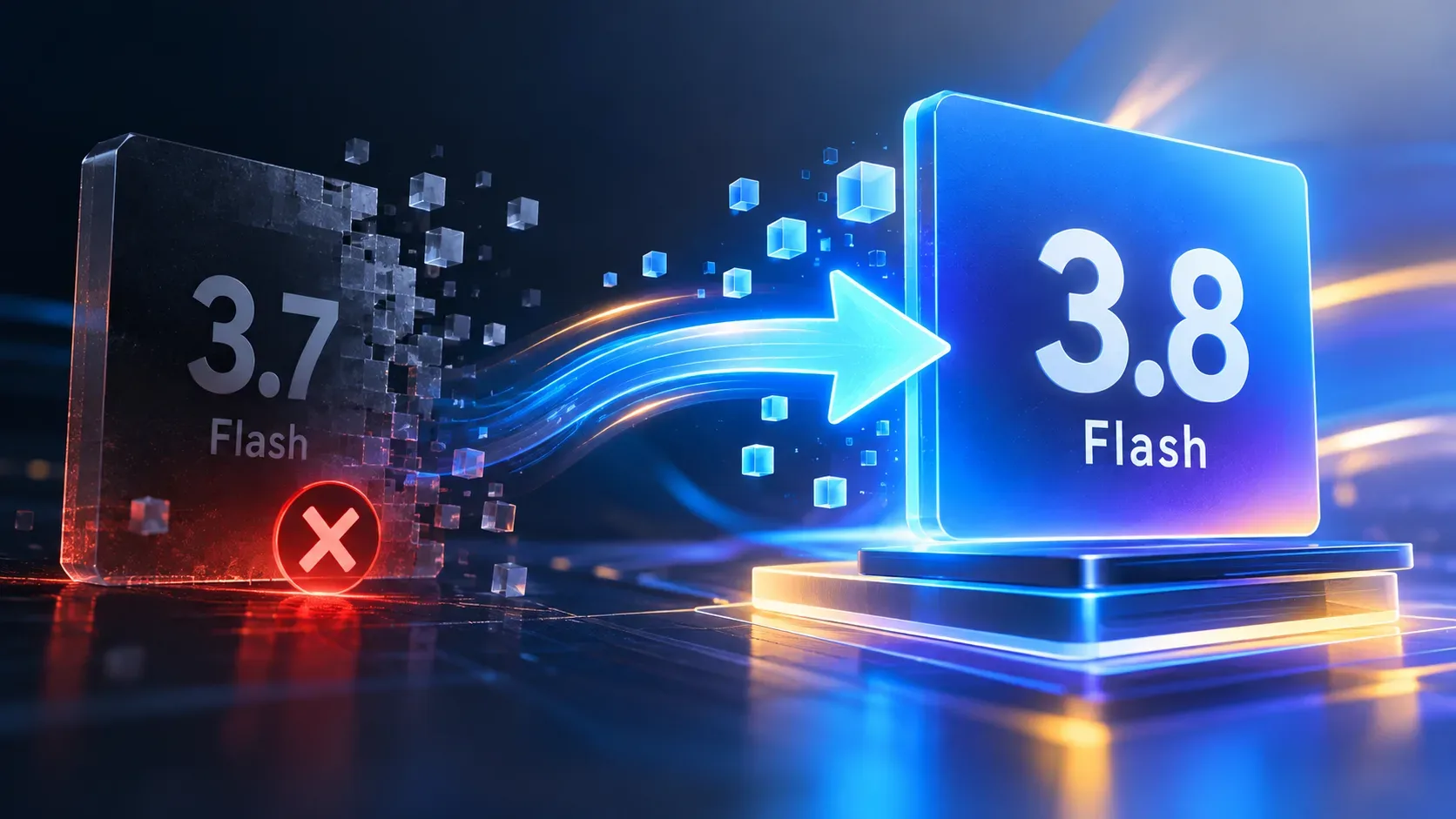
Gemini 3.7 Flash was deprecated as a selectable model on October 8, 2026, but the endpoint identified as gemini-3.7-flash was not shut down. According to Google, requests sent to that model ID in the Gemini API are automatically routed to gemini-3.8-flash. That is why software still requesting 3.7 may get 3.8 behavior. The documented change concerns routing and the model serving the request, not proof that all calls to the older endpoint now fail.
Google's October 8 release notes and deprecation schedule make that distinction. The documentation was checked on October 25, 2026. DTech did not run the API or measure its outputs; this article explains the vendor's published behavior, which developers should verify in their own environments.
What changed on October 8
Google deprecated Gemini 3.7 Flash and named Gemini 3.8 Flash as its replacement. It also removed 3.7 from the selection menu in Google AI Studio, Google's development environment. That does not mean every technical access point was removed. The documentation explicitly says the old route remains available and forwards requests to the new model.
| Model ID | Documented status on October 25, 2026 | What it means for integration |
|---|---|---|
| gemini-3.7-flash | Deprecated; no longer selectable in Google AI Studio; API requests routed to 3.8 | Not a reliable way to pin execution to model 3.7 |
| gemini-3.8-flash | Stable replacement; no shutdown date announced in the schedule reviewed | Recommended ID for new calls and migration |
In the deprecation schedule, the shutdown field for 3.7 is marked N/A, with an explicit note that the endpoint is not shutting down. That entry is not an expiration date. Google's documentation also distinguishes deprecation, when a model is no longer supported or recommended, from shutdown, when the service is turned off and its endpoint becomes unavailable.
Why does the API return 3.8 when the code asks for 3.7?
An API is an interface through which software requests work from a service. A model ID is the text identifier used in a request to select the model. Here, Google keeps the older logical route but associates it with the successor. That is routing on the service side, not an automatic update to the application's source code.
Consequently, seeing gemini-3.7-flash in configuration files, code or request logs does not establish that 3.7 processed a task. Neither does an HTTP success status: it confirms that the request was served, not which model actually generated the output. Developers should compare the requested ID with current documentation and any runtime metadata available in the API they use, without assuming all endpoints expose identical fields.
This routing is documented for the specified identifier in the Gemini API. It does not establish the same switch in the consumer Gemini app or how other platforms, including third-party integrations or Google Cloud services, handle every configuration.
What could change in application behavior
The Gemini 3.8 Flash model specification lists text, image, video, audio and PDF inputs, with text output. Its limits are 1,048,576 input tokens and 65,536 output tokens. Tokens are processing units for text and other modalities used to express service limits and billing. The older 3.7 specification shows the same maxima, but equal limits do not guarantee identical outputs, latency, prices or compatibility.
Google's migration guide recommends the reasoning levels low, medium (the default) and high. The minimal setting is unsupported in 3.8 and may cause an error. The guide also recommends replacing thinking_budget with thinking_level, reviewing sampling parameters deprecated across Gemini 3, and checking multi-step conversations, function calls and thought-signature preservation according to the API and SDK actually in use.
Google claims improvements in long-running coding and multi-step agents, but those vendor statements are not an independent evaluation of this migration. An application may depend on output structure, tool use, execution time and token consumption, so the switch needs testing before production deployment.
Developer migration checklist
- Locate the old ID. Search for gemini-3.7-flash in configuration, code, deployment secrets, batch jobs and tests, separating direct Gemini API calls from intermediaries.
- Change the model identifier. Google's recommendation is to target gemini-3.8-flash explicitly instead of depending indefinitely on automatic routing.
- Review request parameters. Confirm the SDK version and API surface. The official guide replaces thinking_budget with thinking_level, and minimal does not work. It also calls for reviewing temperature, top_p, top_k, candidate_count and prefilled turns under Gemini 3 guidance.
- Recheck conversations and tools. Where applicable, verify turn continuity through previous_interaction_id, function calls, response structures and thought signatures needed by the workflow.
- Run actual tests in your environment. Compare representative inputs, output quality, failures, token consumption, runtime, quotas and tool integration. Roll out gradually if regressions would matter.
- Update observability and documentation. Record the requested ID separately from the verifiable effective model, and maintain migration notes, usage limits and a rollback plan consistent with still-supported models.
This checklist is derived from documentation; DTech did not execute or certify the steps. The examples and parameter changes in Google's guide apply to the interfaces it describes and should not be copied into legacy or third-party clients without checking compatibility.
Pricing and availability in Brazil
In the pricing table reviewed for the Gemini API paid Standard tier, 3.8 Flash costs US$0.75 per 1 million input tokens and US$3.75 per 1 million output tokens, including thinking tokens in output billing, through December 31, 2026. The table announces US$1.50 and US$7.50, respectively, starting January 1, 2027. Caching, tool usage, batch processing and other tiers have separate rules. These are US-dollar API usage rates, not a Gemini app subscription or a conversion to Brazilian reais.
Brazil is included on Google's list of supported countries for the Gemini API and Google AI Studio. This establishes regional inclusion for those services, not unrestricted access for every account, plan, feature or outside integration. Developers still need to verify eligibility and quotas in their own projects.
The distinction that prevents a false diagnosis
It is accurate to say that Gemini 3.7 Flash was deprecated and replaced. The sources do not support saying that its older API endpoint was shut down on October 8 or that requests using its legacy ID still necessarily run 3.7. Google documents the combination behind the confusion: a deprecated model, a reachable endpoint and requests routed to 3.8 Flash.