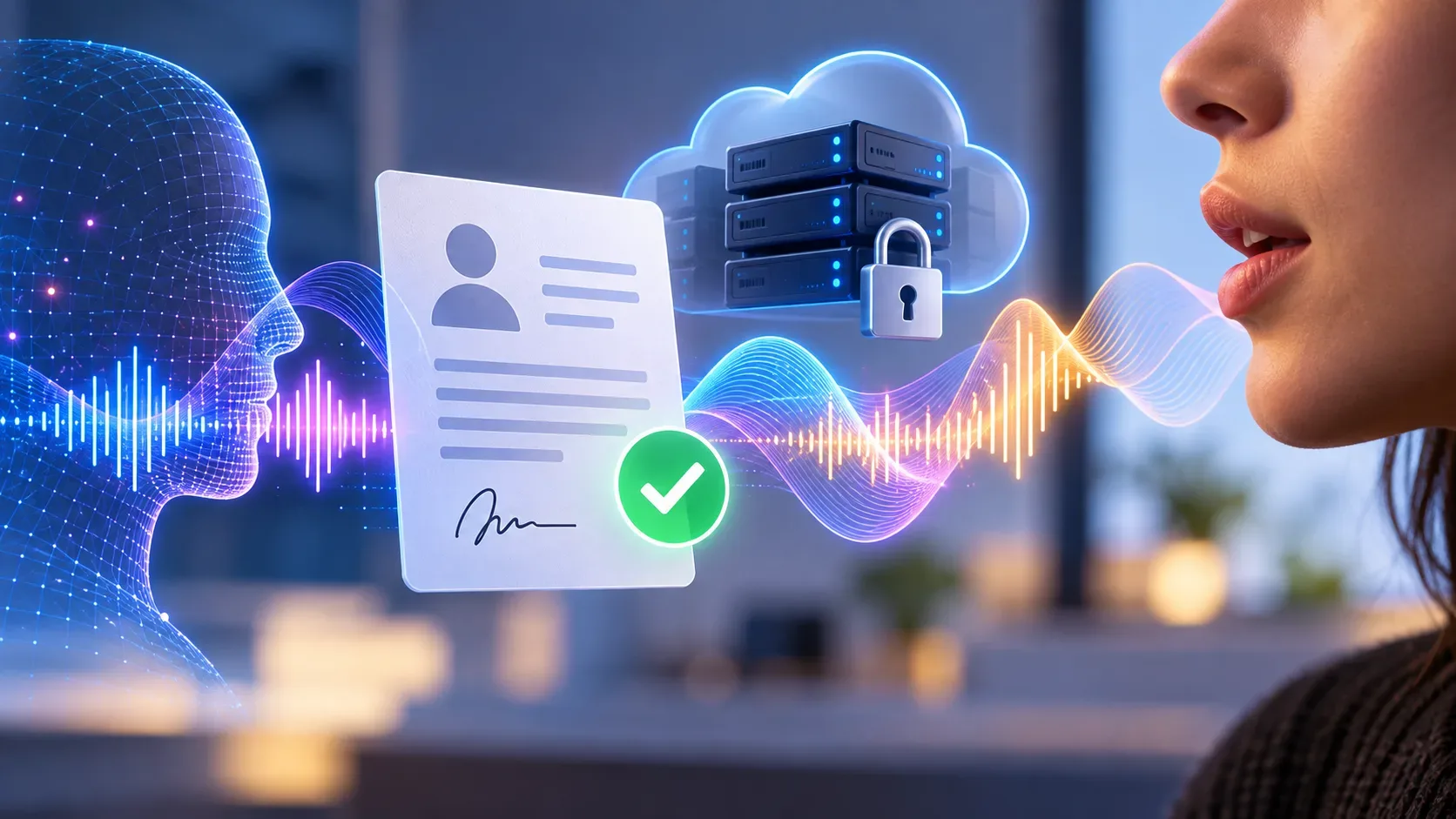
Voice cloning in the Gemini API requires two recordings from the same adult: a voice sample and a separate recording of the mandatory consent statement, which can be spoken in Brazilian Portuguese. The Voices API is in beta; after consent verification, an application can generate speech using that voice. Developers choose between storing a voice profile in a Google project and keeping an encrypted key in their own system. Neither option removes personal-data responsibilities.
What the Gemini API provides, and what it does not
Google’s voice replication guide documents the POST /v1beta/voices endpoint with the replicated voice type. It creates a reusable representation of a person’s vocal characteristics, not a publicly retrained Gemini model. The documented compatible synthesis models are gemini-3.8-flash-tts and gemini-3.8-flash-lite-tts. TTS means text-to-speech: converting written text into spoken audio.
Google AI Studio offers a browser-based way to record or upload clips, preview the result, and obtain its identifier. This is a development interface, not the consumer Gemini app. The Voices endpoint and API reference identify the feature as beta, which must not be confused with general availability or assured access for every account.
Which two recordings are required?
- Reference audio (source_audio): 10 to 30 seconds of clean, natural speech by the person whose voice will be replicated.
- Consent audio (consent_audio): the same adult must clearly record the exact published consent statement in one of the supported languages.
- Audio preparation: the Gemini API guide recommends mono WAV, 16-bit PCM, at 24 kHz. Avoid music, background noise, echo, and overlapping speakers. Using the same microphone and setting for both recordings helps verification.
Both recordings are submitted as audio data when the voice is created. Technical consent verification alone does not establish all commercial voice rights, verify a speaker’s civil identity, or authorize every later use of synthetic speech.
What is the consent statement in Brazilian Portuguese?
The official list of 30 supported locales includes pt-BR. The speaker must read this Portuguese statement verbatim: Eu sou o proprietário desta voz e autorizo o Google a usá-la para criar um modelo de voz sintética.
The spoken statement authorizes Google to use the voice to create a synthetic voice model. A developer-written translation, a different speaker reading it, or a checkbox alone does not replace consent_audio. For an application serving third parties, the purpose, scope of permission, and a procedure for requesting that use stop should also be documented.
How is the voice used for speech synthesis?
- Use an eligible project and account, review the API terms, and obtain credentials without exposing them in public pages.
- Prepare source_audio and consent_audio from the same adult, then supply both fields in a creation request with voice.type set to replicated.
- Explicitly set store to true or false and choose a supported model when creating the voice.
- For later TTS requests, provide the returned ID or key in the voice configuration. The reference clip does not need to be uploaded again for every synthesis request.
These steps summarize documentation; DTech did not execute the API. Google’s examples use Google GenAI SDK version 2.25.0 or later for Python, @google/genai version 2.24.0 or later for JavaScript, or REST calls. These examples do not establish that an individual reader’s account has beta access.
Where is the replicated voice stored?
| Setting | Returned value | Management and documented lifetime |
|---|---|---|
| store=true, Google-managed profile | voice_... ID | Stored in the project; list, inspect, or delete using Voices operations. Up to 200 stored voices per project and expiry after 1 year of inactivity. |
| store=false, client-managed key | Encrypted voicekey_... key | No Google-managed persistent voice profile; the application must secure the key. The key expires after 7 days. |
Google’s own documents disagree on the implicit default: the replication guide calls store=true the default, while the CreateVoice API reference says store=false is the default. Do not rely on an omitted setting. Send store=true or store=false explicitly and inspect the returned value. The one-year period concerns the stored voice, measured from last use; it does not establish retention for every uploaded audio file.
Does deleting a voice delete recordings and logs?
No such equivalence is documented. voices.delete removes a stored voice profile from the project but does not prove immediate erasure of the original recordings, operational logs, or copies retained by the developer’s application. Likewise, store=false avoids persistence of a Google-managed voice profile, not all possible processing or retention of data.
The Gemini API logging policy separates developer-owned project logs for supported calls and billing-enabled projects from records kept for abuse monitoring. Project logs have a default maximum retention period of 55 days, adjustable to 7, 14, 28, or 55 days, while datasets saved from logs may last longer. The Interactions API has its own store setting for interaction state, separate from the CreateVoice store option.
Under the current terms, Google does not use prompts and responses from paid services to improve its products, although limited abuse-prevention and legal-compliance logging remains possible. For unpaid services, the terms permit submitted content to be used for product improvement and human review and warn against sending personal or sensitive information. A project associated with an active billing account affects how the terms classify the service; free-tier use should not be assumed suitable for personal voice recordings.
Is the feature available in Brazil, and what safeguards matter?
Brazil appears on Google’s general list of supported regions for the Gemini API and AI Studio, and pt-BR is included in the consent-language list. That establishes general regional and language coverage, not guaranteed availability of the beta feature for every Brazilian account, project, or plan. Actual eligibility needs checking in an authorized environment before deployment claims are made.
Brazil’s LGPD protects information about identified or identifiable individuals and gives special protection to biometric data linked to a person. Brazil’s ANPD has also warned about scams involving voice deepfakes. The API’s spoken-consent step is a technical safeguard, not automatic certification of compliance with data-protection law. A real application must address an appropriate legal basis, purpose, security, retention, withdrawal processes, and responsibility for generated recordings.
- Obtain specific authorization before recording, reusing, or publishing an identifiable voice and retain suitable evidence of permission.
- Protect voice IDs and keys with access controls; never expose them in public code or share recordings unnecessarily.
- Tell users when audio is synthesized, and provide a process to suspend use, delete profiles, and handle copies under the developer’s control.
- Review voice settings, project logs, interaction storage, and service terms separately before treating the system as production-ready.
The documentation confirms the beta workflow for creation, consent, synthesis, and management. On its own, it does not provide independent measurements of cloning fidelity, a guarantee against misuse, or one universal deletion deadline for every data category.